

PDSA for problem solving, decision quality, A3 thinking, RBA, and more
The Swiss Army knife for scientific reasoning, learning, and improving

Special acknowledgment and thanks to Youngjae Kim, Chief Lean Transformation Officer, Assistant Deputy Director, Policy and Planning (Lean Transformation Branch) at the California Department of Public Health.
What do PDSA, decision quality, and design thinking have in common? (Figure 1)
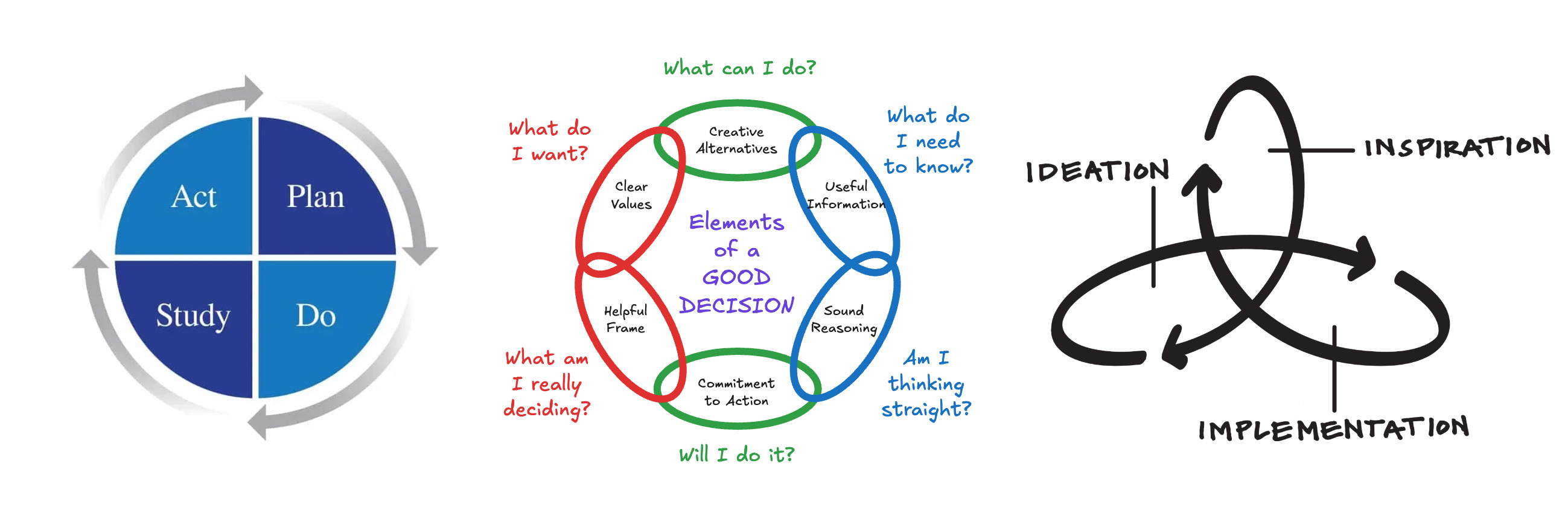
They can all be conceptualized and deployed using PDSA. PDSA is universally applicable.
I love PDSA!
PDSA stands for Plan-Do-Study-Act. PDSA is the cycle of scientific thinking, action, and continuous improvement. Unconsciously, PDSA thinking and problem solving is part of human nature: it is how we predict and try things, learn, adapt, and improve. Being intentional about embracing PDSA supercharges your reasoning, deciding, learning, and improving.
In my recent blog on PDSA, “PDSA thinking for daily problem-solving,” I covered how to use PDSA for
scientific thinking,
single-loop and double-loop learning, and
deductive, inductive, and abductive reasoning
PDSA is also a powerful way to organize your strategic, problem solving, and innovation frameworks. Today I demonstrate this with four tables covering
PDSA core and comparison to design thinking and lean startup.
PDSA decision making using decision quality (DQ) requirements
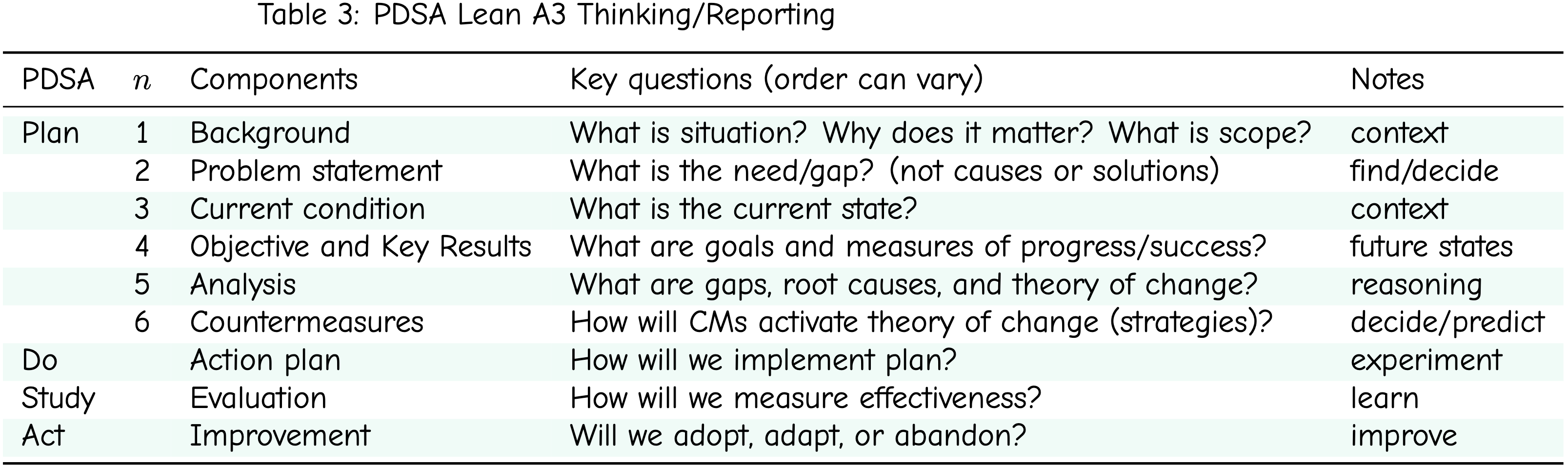
PDSA lean A3 thinking/reporting
PDSA Results-Based Accountability (RBA)
In lean, standard work is “the agreed-upon, best-known, least wasteful way of doing the work today until a better way is found.” Standard work provides a structure to communicate, train, practice, and deliver an expected sequence of activities. Starting with continuous self-improvement, leader standard work is developing people to solve problems and improve performance (individual, team, organization).
PDSA supercharges your leader standard work!
The tables below are available as markdown and LaTeX tables on Github.
PDSA problem solving core
Table 1 uses PDSA to organize PDSA problem solving. The steps are self-explanatory. Tables 1 also compares the PDSA core components to design thinking1 (aka, human-centered design) and lean startup.2 PDSA aligns with and can accommodate the best practices from these innovation frameworks.
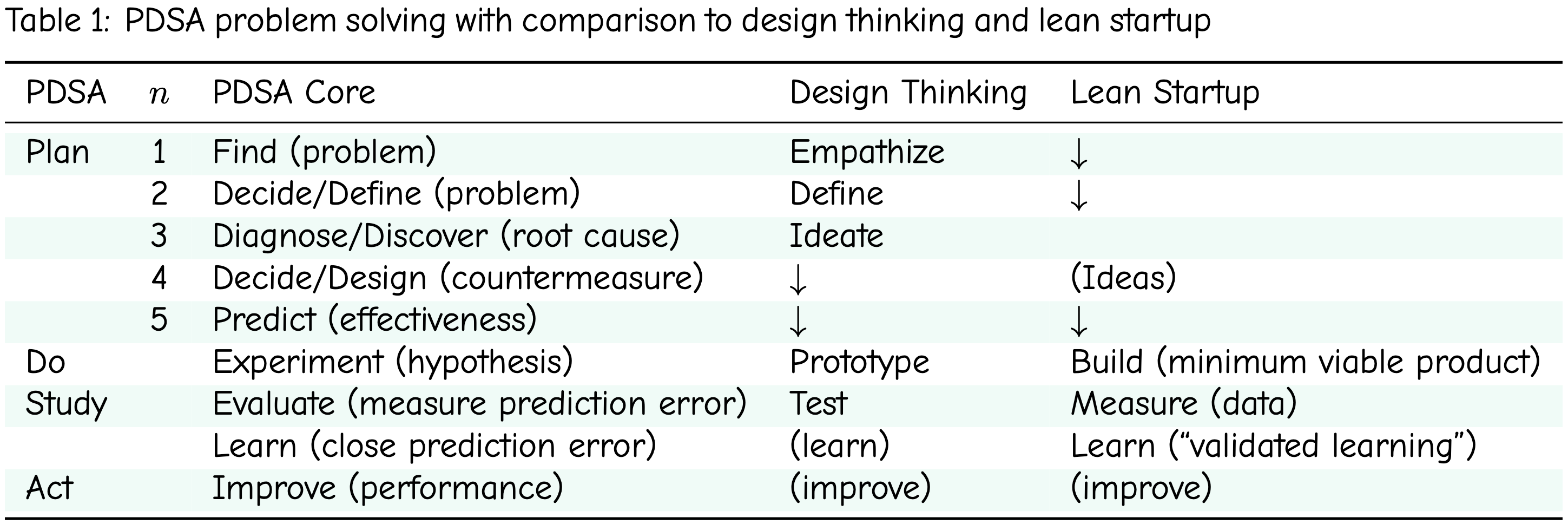
IDEO describes design thinking as having a beginner’s mindset with three core activities: inspiration (empathize, define), ideation, and implementation (prototype, test). Eric Ries, author of The Lean Startup, summarizes lean startup with three words: build, measure, learn. Both use the Power of 3 to make their innovation frameworks memorable. The key takeaway is that learning other innovations frameworks does not detract from PDSA; they all use — more or less — the same iterative process of diagnosis, discovery, implementation, evaluation, learning, and improvement. Design thinking emphasizes human-centered empathy. Lean startup emphasizes building a minimum viable product (MVP) for testing and learning. These powerful concepts can be integrated into your PDSA thinking and problem solving.
IDEO also calls out the importance of good decision making as the process of divergent and convergent thinking (Figure 2).
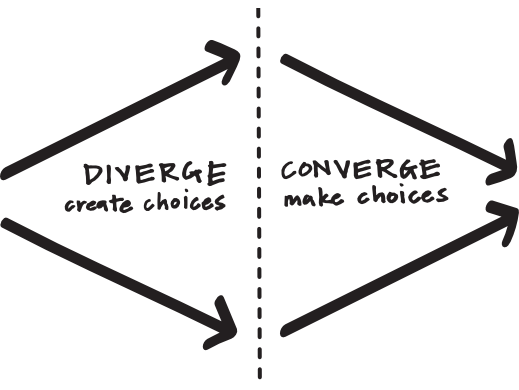
Figure 3 depicts PDSA problem solving as a series of key decisions. The quality of problem solving depends on the quality of decision making.
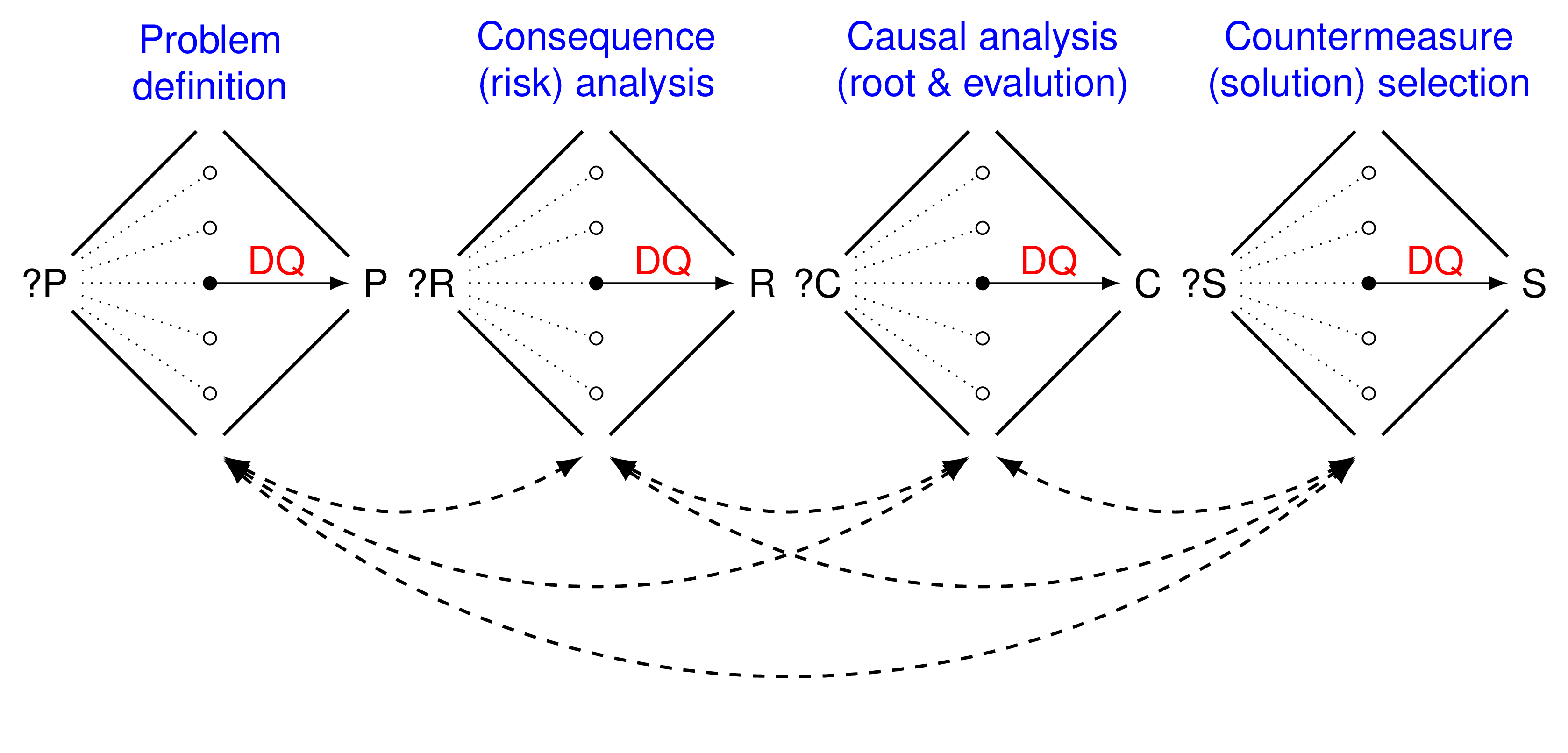
Not only is PDSA problem solving a series of key decisions, decision quality requirements can be organized as PDSA.
PDSA for the quality of decision making
Table 2 uses PDSA to organize decision quality (DQ) requirements for decision making and continuous improvement. The DQ requirements are like links in a chain: the quality of a decision is only as good as its weakest link.
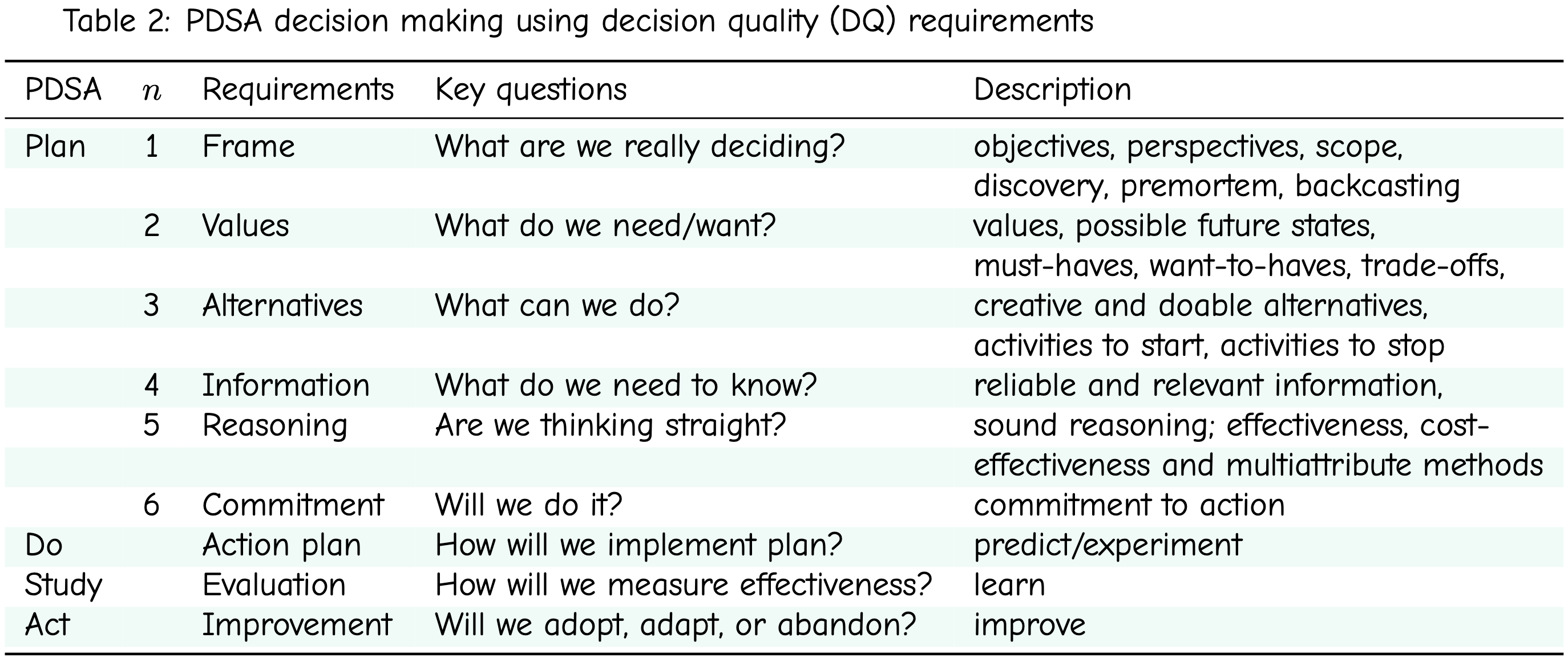
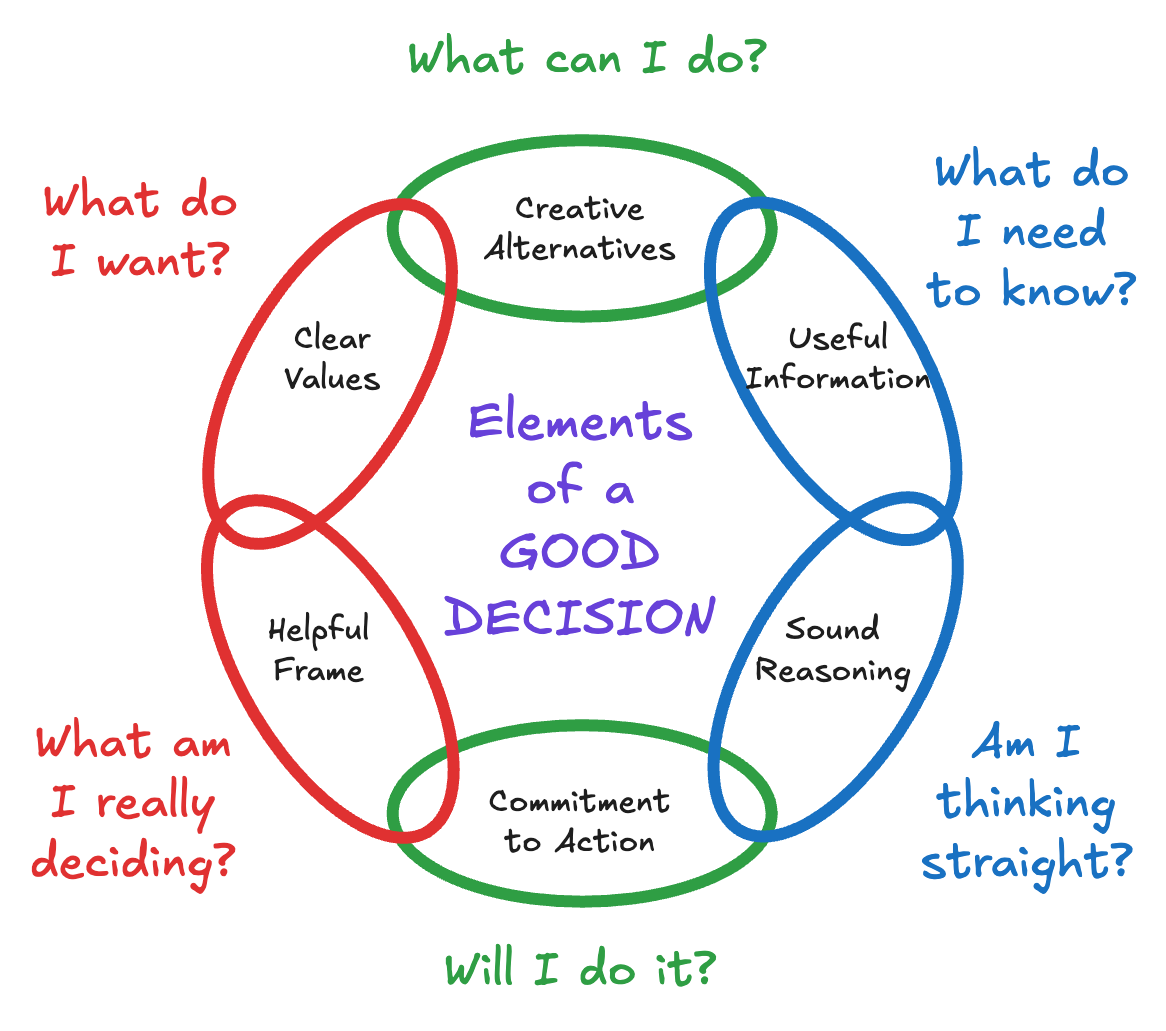
Figure 4 depicts the DQ requirements. PDSA operationalizes DQ into a continuous improvement process.
To learn more about decision making, visit TEAM Public Health here:

PDSA lean A3 thinking/reporting
Lean practice is “systematically developing people to solve problems and consuming the fewest possible resources while continuously improving processes to provide value to community members and prosperity to society.”
Table 3 uses PDSA to display the components of A3 thinking which is used for teams solving complex problems. A3 reports are usually summarized into one page (A3 paper), or the way I prefer, two pages (8.5in x 11in).
To learn more about lean visit: https://teampublichealth.substack.com/t/lean.
PDSA Results-Based Accountability
Results-Based Accountability (RBA) is a results-based framework for improving communities for families and children. RBA is also an epidemiologic framework for guiding a collective impact initiative. RBA complements lean and emphasizes:
Aspirational, outcomes focus (“Is anyone better off?”)
Framework for designing and selecting indicators
Root cause analysis (“What’s the story behind the curve?”)
Decision criteria for selecting promising, effective strategies
Table 4 list the 6 RBA questions. To learn more download the RBA Accountability Guide.
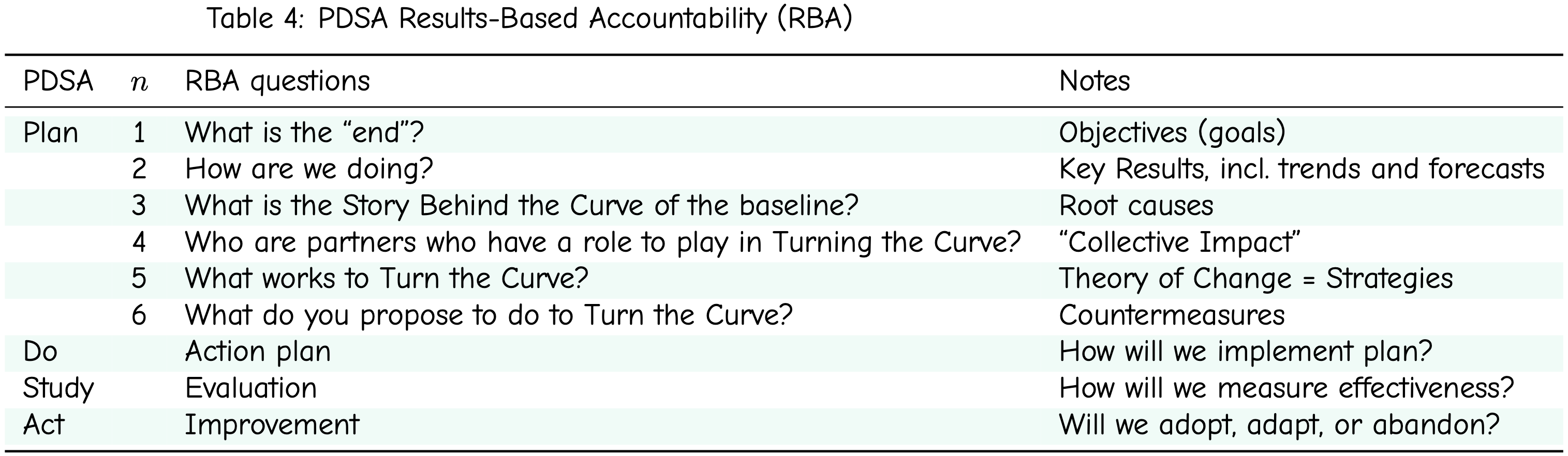
Whereas lean A3 thinking tend to focus on organization operational processes, RBA was designed to engage and mobilized communities towards a common goal.
Summary
PDSA is for scientific thinking, problem solving, decision making, and much more (deductive reasoning, inductive reasoning, abductive reasoning).
PDSA is the foundation of lean practice, including A3 thinking, and RBA.
PDSA also enables you to learn, evaluate, and integrate more effectively other innovation frameworks such as design thinking and lean startup.
PDSA is a standard for evaluating new and emerging innovation frameworks.
Thanks for supporting TEAM Public Health by reading this blog! Please share.
NOTE: The tables below are available as markdown and LaTeX tables on Github.
TEAM Public Health is a FREE — not-for-profit and reader-supported — blog. All content is freely available to all and is designed to be evergreen.
Serving with you,
Appendix — Lean 8Ds
Lean has similar frameworks that get confused with A3 thinking. To learn more, read this article. Here is quick summary:
“The 8Ds or the eight disciplines were developed by Ford in the 1980s as a team problem-solving approach. The A3 process is a Toyota-pioneered practice of getting the problem, analysis, corrective actions, and action plan on a single sheet of large (A3) paper, often with the use of graphics. The main difference is that the 8Ds, summarized below, are oriented toward organizing and leading a team through a structured problem-solving process.”
The 8Ds
Form a team with product or process knowledge
Describe the problem in quantifiable terms such as what, where, how many, etc.
Implement containment actions to isolate the problem from customers.
Determine and verify all applicable causes
Select and verify permanent corrections
Implement the best corrective actions
Take actions to prevent the problem from recurring
Recognize and congratulate the team
As an exercise, convert the 8Ds into a PDSA table.
Footnotes
Ries, Eric. The Lean Startup: How Today’s Entrepreneurs Use Continuous Innovation to Create Radically Successful Businesses. First international edition. Currency, 2017.